Black Forest Drive and the Fine Art of Losing Your Mind Over a Bike Lane
There are few things more reliable in Australian public life than a community Facebook group discovering a bike lane.
Not a sinkhole. Not a toxic spill. Not a proposal to replace the town hall with a vape shop and a car wash.
A bike lane.
Paint appears. Lanes change. Someone mentions “active transport”. And suddenly half the internet is dressed as a traffic engineer, an emergency services consultant, a small-business economist and a constitutional lawyer.
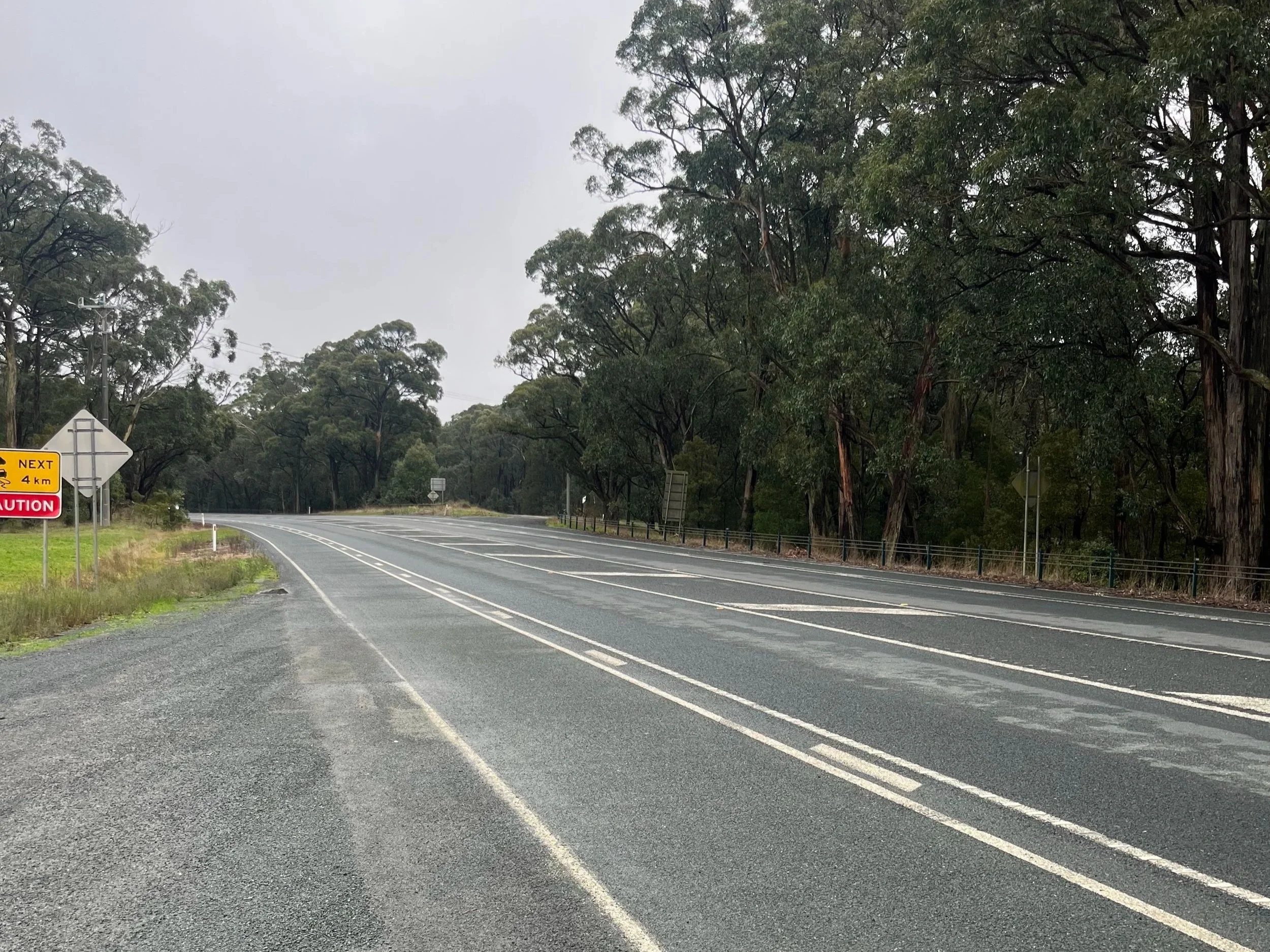
Which brings us to Black Forest Drive, the leafy road between Woodend and Macedon that has spent the past few years being treated as if the state government personally drove a Bobcat through the front bar of the Victoria Hotel.
The crime? Taking a legacy highway, calming it down, making it one lane each way, adding wide separation, safer turning space, pedestrian refuges, islands, rumble strips, intersection work and continuous bike lanes.
In other words: making an old road do a modern job.
Naturally, civilisation almost ended.
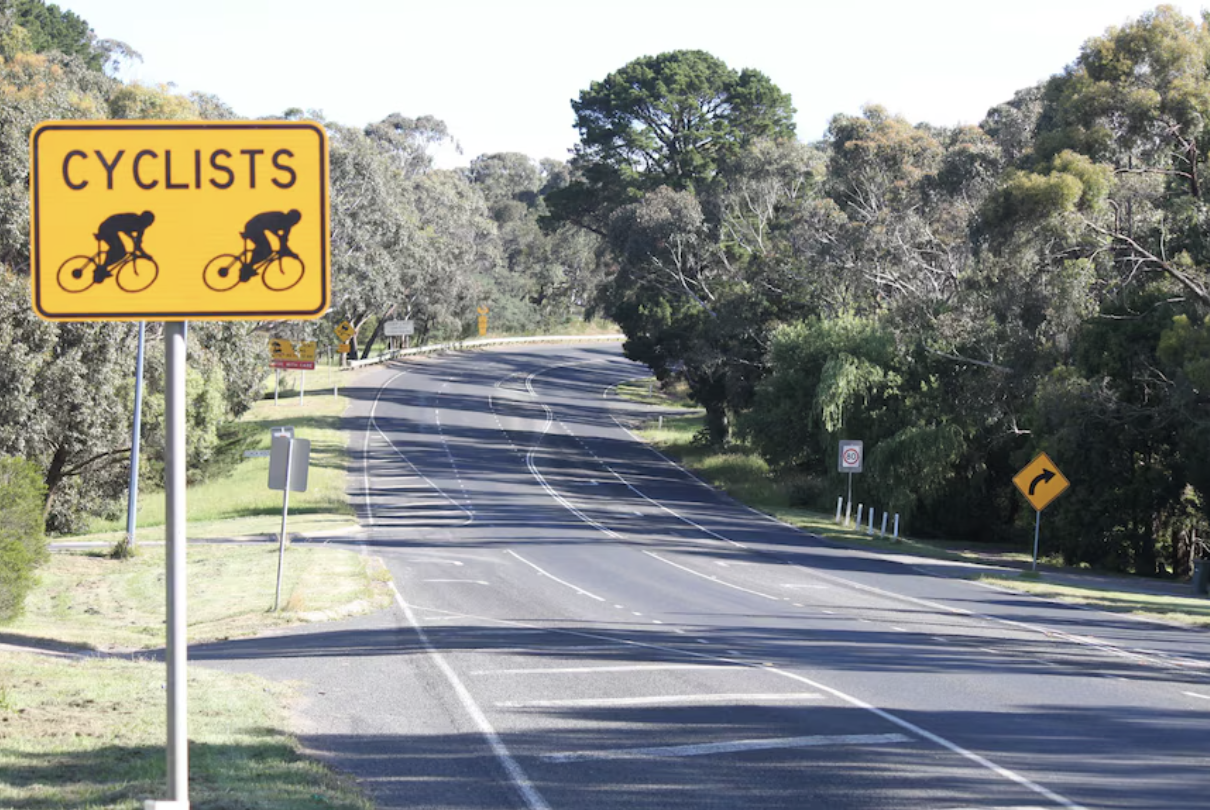
Black Forest Drive was not born as some sacred village laneway where children skipped to school and locals waved at passing horses. It was once part of the Calder Highway, the old Melbourne-to-Bendigo route. Then the freeway arrived. The Gisborne-to-Woodend Black Forest section opened in 2000, and the Woodend bypass followed in 2001. The big, fast, intercity job moved to the Calder Freeway. Black Forest Drive was left as a kind of road-historical hangover: wide, fast, overbuilt in places, and still behaving like it had a highway job to do.
But it no longer did.
That is the bit people keep pretending not to understand. Black Forest Drive is not the Calder Freeway. The freeway is the freeway. It exists. It is large. It has multiple lanes. It was built precisely so local roads did not have to keep cosplaying as the main road to Bendigo.
Black Forest Drive became a local connector between Woodend, Macedon, Gisborne and freeway access points. A useful road, yes. A busy road at times, sure. But not a museum exhibit. Not a monument to the sacred overtaking lane. Not a place where 2001 road geometry must be preserved in amber because Dazza once made it to Macedon six seconds faster in a VN Commodore.
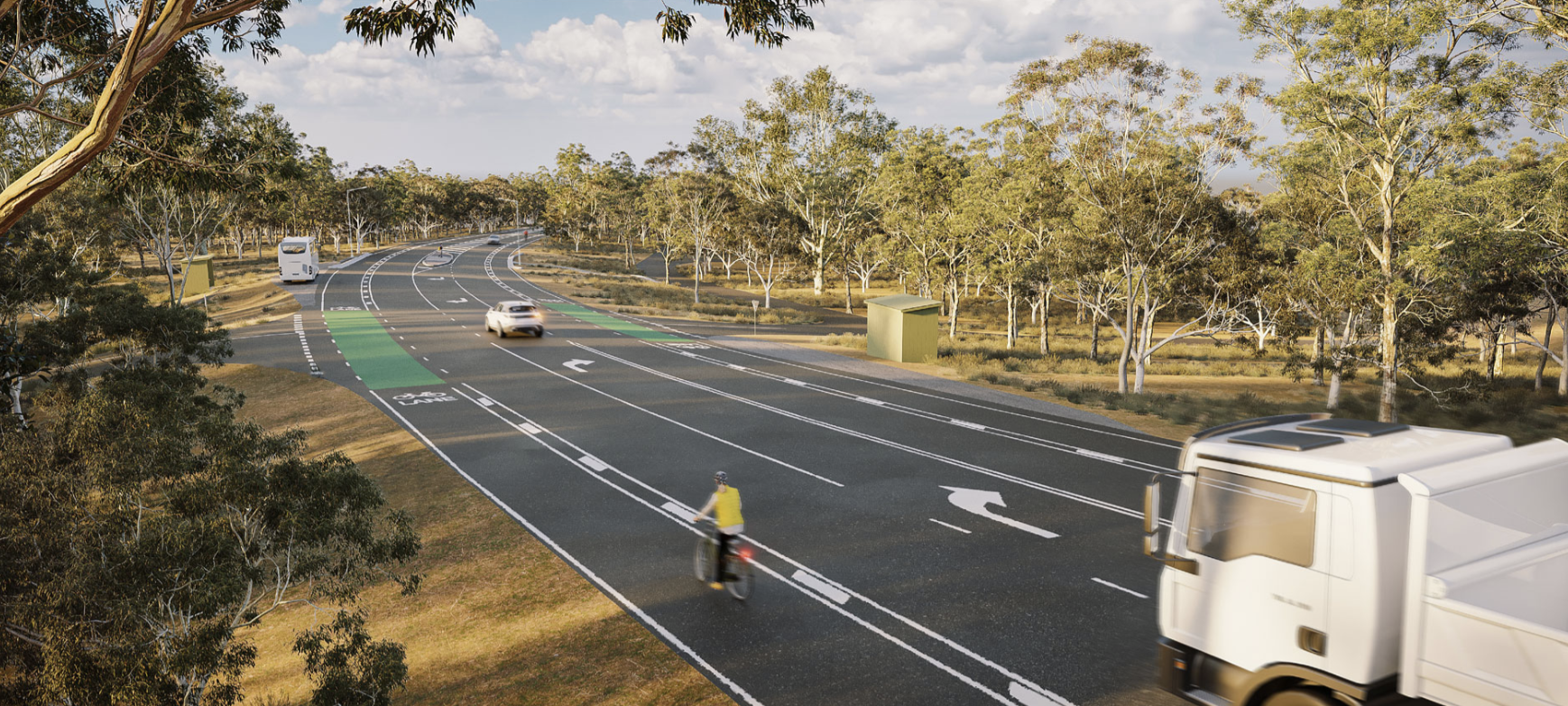
Victorian Government Department of Transport Concept Image
The new design is not especially radical. One lane each way. Dedicated bike lanes. A painted centre median for turning. Pedestrian refuges. Safer crossings. Resealing. Better line marking. Audio-tactile markings. Lower speeds around risk points. The kind of thing that, in a functioning transport culture, would be called “safety works” and everyone would go back to arguing about rates.
Instead, Black Forest Drive became a small-town culture war with gum trees.
The objections followed the usual script.
First: “Nobody rides there.”
This is the all-time classic. Nobody rides there, therefore do not make it safe to ride there. Genius. Nobody swims in a crocodile enclosure either, but we do not conclude the water is unpopular.
People avoid hostile roads because hostile roads are hostile. That is not evidence against bike lanes. It is the entire argument for them.
Second: “We don’t need bike lanes.”
Who is “we”? The loudest twelve people on Facebook? The person who drives it twice a week and has decided that their convenience is the whole civic brief? The bloke who has never ridden a bike as transport but is absolutely certain no one else should either?
Roads are public space. They are not reserved for the most confident driver with the firmest opinion. A road between two towns should work for drivers, cyclists, pedestrians, school kids, bus users, walkers, locals and visitors. The fact a bike lane does not personally benefit you does not make it useless. Hospitals are also annoying when you are not in one.
Third: “It will slow everyone down.”
Transport Victoria estimated the speed changes would add less than a minute to the journey between Woodend and Macedon.
Less than a minute.
That is not a transport catastrophe. That is the time it takes to misplace your sunglasses, accept Bluetooth terms and conditions, or reverse out of a driveway with a hedge in the wrong place.
If your day is destroyed by losing less than sixty seconds on a road with a history of fatal and serious crashes, the problem may not be the bike lane. It may be your relationship with time, mortality and other people existing.
Fourth: “It’s dangerous now because cars have less room.”
No. What is dangerous is a road designed like it still wants to be a highway when it is not one.
The old layout encouraged speed, ambiguity and impatience. A wide road can feel safe to a driver because it gives the illusion of space. But that same width can be horrible for everyone else. It invites faster driving. It makes crossing harder. It encourages sloppy overtaking. It turns anyone on a bike into a moving inconvenience.
The new layout tells drivers what the road is: one lane each way, a centre area for turning, and visible space for bikes. That is not confusion. That is hierarchy. That is the road finally speaking in complete sentences.
Fifth: “Emergency vehicles won’t get through.”
This one appears whenever any road anywhere is made safer. Bike lane? Emergency vehicles. Speed hump? Emergency vehicles. Pedestrian crossing? Emergency vehicles. Outdoor dining? Emergency vehicles. Someone puts a pot plant near a kerb and suddenly half the town has become a volunteer CFA access consultant.
Emergency access matters. Of course it does. But road safety design is not created by simply making every road as wide and fast as possible forever. If that were true, the safest town in Victoria would be a B-double depot.
The project included turning lanes, medians, refuges and line marking. It was designed by road authorities, not a cycling influencer with a can of Dulux and a dream.
Sixth: “Cyclists don’t pay rego.”
Excellent. We have reached the children’s table.
Registration does not pay for local roads in the neat little way people imagine, and cyclists also drive, pay rates, pay taxes and participate in society without needing to present a receipt every time they leave the house. Also, a person on a bike causes a tiny fraction of the road wear, danger, noise and space demand of a car.
If we charged road users according to damage and space consumed, cyclists would be owed a hamper.
Seventh: “The community is furious.”
Some of the community is furious. That is different.
Woodend had 6,732 people at the 2021 Census. Macedon had just over 2,000. Macedon Ranges Shire is now estimated at more than 53,000 people. A noisy Facebook thread is not the voice of the people. It is the voice of people who comment on Facebook threads.
This matters because bike-lane opposition often works by theatre. It creates the feeling of mass revolt. It floods the zone. It turns every post into a grievance scrapbook. It makes a small, motivated group look like a democratic uprising because everyone else has dinner to cook.
But public policy cannot be run by whoever types in capitals first.
And here is the uncomfortable bit: Black Forest Drive had a serious safety problem. Road authorities recorded multiple fatalities and serious injury crashes after 2001. Cyclists had been warning about the road for years. In 2023, even cycling groups were arguing earlier plans did not go far enough. So the lazy story that “cyclists got everything and drivers got punished” is nonsense. The road was dangerous. People asked for it to be fixed. It was fixed in a way that still lets drivers drive.
That last point seems to have been lost in the smoke.
Drivers still have a lane. The road still exists. Woodend has not been cut off from Macedon like West Berlin. You can still get to the freeway. You can still get to Gisborne. You can still buy coffee, visit friends, collect children, tow something unnecessarily large, and complain about cyclists from the comfort of a climate-controlled cabin.
What has changed is that the road now admits other people exist.
That is what the outrage is really about. Not safety. Not travel time. Not “consultation”. Not the sanctity of regional mobility. It is the emotional shock of a road being redesigned for more than one type of user.
And good.
Because that is what has to happen everywhere.
Black Forest Drive should not be a fiasco. It should be a template. Take roads that are too wide, too fast and too hostile. Ask what job they actually do now. Stop worshipping old highway geometry. Build for the people who live there, ride there, cross there, walk there, wait for buses there and would maybe like to get between towns without being treated as an obstacle.
Then brace for the Facebook weather event.
Because it will come. It always comes. The same objections. The same panic. The same “nobody asked for this” from people who somehow missed the years of asking. The same “waste of money” from people who think road spending is only legitimate when it arrives in the shape of more asphalt for cars.
Let them howl.
The rest of us should pay attention to what happens after the paint dries. Do more people ride? Do drivers adjust? Do school kids get safer crossings? Do near-misses fall? Does the road feel less like a half-retired highway and more like a local connection through a beautiful part of Victoria?
That is the story worth telling.
Build the damn bike lanes.
And if your town has fought this fight — if bike lanes were built, blocked, watered down, ripped up, delayed, or buried under the usual avalanche of nonsense — we want to hear from you - email us at info@lavelocita.cc
Send us the screenshots, the excuses, the council theatre, the before-and-after photos, the victory laps and the disasters.
Because Black Forest Drive is not unique.
It is just the latest place where a sensible road safety project had to survive the ancient Australian ritual of people losing their minds because someone painted space for a bike.
Build the damn bike lanes.